






Your next customer might encounter your business inside an AI answer before visiting your website. That changes what your content needs to accomplish. The page should answer the question, support the answer, and give someone a reason to keep reading.
Adding an FAQ section won’t handle all of that.
Research into AI search points toward a broader approach: useful information, clear explanations, credible evidence, and a brand presence beyond your own website. Here’s what the findings actually support, and how to apply them.

What is AEO
Answer engine optimization (AEO) is the practice of improving your content and online presence so answer engines find, understand, and reference your business in relevant answers. Those answers appear across tools such as ChatGPT, Perplexity, and Google’s AI search features.
AEO includes writing direct answers, publishing reliable information, keeping pages accessible, and checking how AI systems describe your business.
The terminology overlaps with SEO and generative engine optimization, or GEO.
| Approach | Main focus | Example outcome |
| SEO | Improve visibility through organic search | Your product guide appears for a relevant search |
| AEO | Improve visibility in direct answers | An answer references your guide or names your business |
| GEO | Improve visibility in generative AI responses | An AI comparison includes your product and cites supporting information |
These aren’t separate boxes. Google describes work on its generative search features as part of SEO. Our guide to generative engine optimization covers the broader brand visibility piece.

Why does answer engine optimization matter
AI answers change the relationship between visibility and website traffic.
Pew Research Center analyzed browsing data from 900 U.S. adults, covering 68,879 unique Google searches. Users clicked a traditional search result in 8% of visits with an AI summary, compared with 15% without one. Links inside the summaries received clicks in just 1% of visits with a summary.
The study tracked March 2025 browsing and collected corresponding search results in April. It provides an observational snapshot, rather than a forecast for every business.
The practical implication is straightforward. A citation creates visibility, but a citation doesn’t automatically produce a visit or sale.
Your content needs to answer the immediate question while offering something worth visiting: detailed specifications, original research, a useful tool, or a comparison that helps someone decide.

How should you structure content for AI answers
Start with the questions that affect a purchase, project, or decision. Use customer conversations, support requests, and search query data to identify them.
For a product page, that means compatibility, materials, dimensions, maintenance, and limitations. For a service page, buyers need scope, deliverables, pricing factors, and responsibilities.
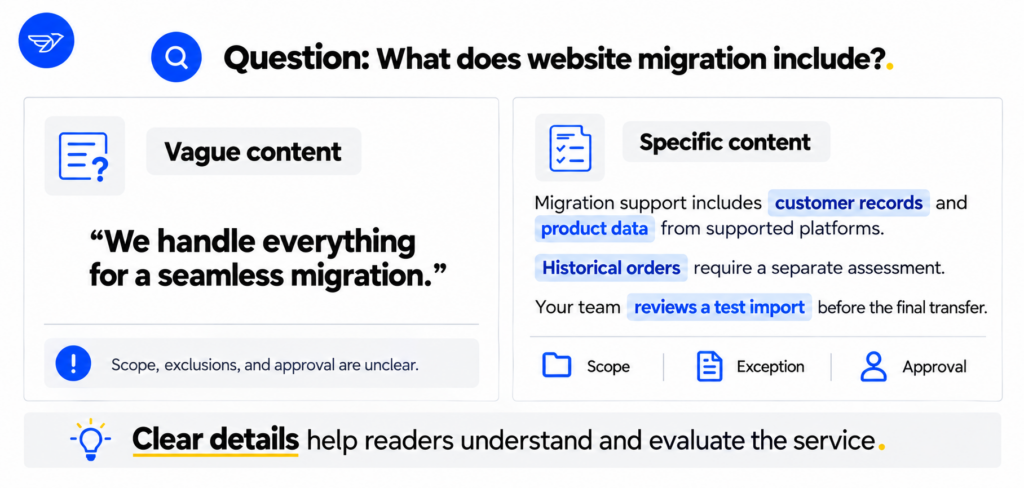
Then organize the answer.
- Use a heading that names the question. “What does website migration include?” tells readers what follows.
- Answer before adding background. Give the essential explanation in the opening paragraph.
- Keep conditions beside the claim. State exclusions and requirements where readers need them.
- Add supporting evidence. Include a documented example, test result, or relevant primary source.
- Explain the next related issue. Keep connected questions together and link to deeper guidance when useful.
Consider this fictional migration service description:
“Migration support includes importing customer records and product data from supported platforms. Historical orders require a separate assessment. Your team reviews a test import before approving the final transfer.”
The paragraph explains the scope, exception, and approval step. “We handle everything” leaves all three unclear.
Use comparison tables when readers need to assess the same attributes across several options. Use numbered lists for processes. Keep explanations in paragraphs when the details depend on each other.
These are editorial choices, not secret ranking requirements. Google explicitly rejects the idea that publishers need tiny content chunks or a particular page length for AI search. Its guidance favors useful content organized for readers.

What evidence supports adding sources and specific details
Researchers affiliated with Princeton University and IIT Delhi developed GEO-bench, a benchmark containing 10,000 queries. Their experiments tested changes such as adding sources, statistics, and quotations. The paper reported visibility improvements of up to 40% in its experimental setting, with results varying by topic and method.
That figure measures the researchers’ visibility metrics. It isn’t a promised increase in traffic, leads, or current Google citations.
The useful lesson is to strengthen the substance behind an answer.
If you publish product testing, explain the conditions and method. If you report campaign results, include the period, baseline, and relevant limitations. If you cite an external study, link to the study and preserve what the finding actually says.
An original observation also needs enough context to stand alone. “Conversions increased” tells readers little. Naming the conversion, comparison period, and changes made gives readers something they can evaluate.
Specificity earns its place by making the answer more useful.

How do YouTube and Reddit fit into AEO
Your website is one source of information about your business. Videos, reviews, and community discussions add others.
Ahrefs studied 75,000 brands and found that YouTube mentions had the strongest correlation with AI brand visibility among the factors it tested, approximately 0.737. Its definition included brand mentions in video titles, descriptions, and transcripts.
That relationship doesn’t prove publishing videos causes AI recommendations. The sample also favored established websites, using a Domain Rating threshold above 40.
The finding supports testing useful video content as part of a broader search strategy. Product demonstrations, technical explanations, and expert interviews give customers more ways to understand your offering. Accurate captions and descriptive titles make those resources easier to use.
Reddit is useful for learning how people phrase questions and challenge claims. In this discussion about AEO and GEO, commenters disagree about definitions, tactics, and measurement. That’s practitioner discussion, not controlled evidence.
Use those conversations to identify unanswered questions. Contribute relevant expertise when appropriate, disclose your connection to the business, and respect community rules.

Do you need special schema or AI files?
Google says no special schema is required for its generative search features. Google also says it ignores llms.txt for Search visibility.
Structured data still has a role in supported search features. It should accurately describe the visible content.
Before adding anything new, check whether your existing pages are accessible, indexable where intended, and connected through working internal links. Confirm that important information loads correctly and that your product or service details agree across the site.
Keep AEO connected to your SEO strategy. Technical problems don’t disappear because the search result contains an AI answer.

How should you measure AEO
Track citations, answer accuracy, and business results separately. Each tells you something different.
Bing Webmaster Tools’ AI Performance report shows citation totals, cited pages, and changes over time across Microsoft Copilot, Bing AI summaries, and selected partner integrations. It also provides sampled grounding queries: the phrases AI systems used to retrieve your content, which aren’t necessarily the user’s exact prompt.
Microsoft Clarity’s AI Visibility dashboard adds page citations, grounding queries, AI referral traffic, and Share of Authority. That last metric compares your citation share with other domains within the same query set where your site appeared.
Clarity also separates branded and non-branded grounding queries. Use that distinction to see whether citations involve your business name or broader topics relevant to potential customers.
For Google, Search Console’s Generative AI performance report provides impressions from AI Overviews and AI Mode.
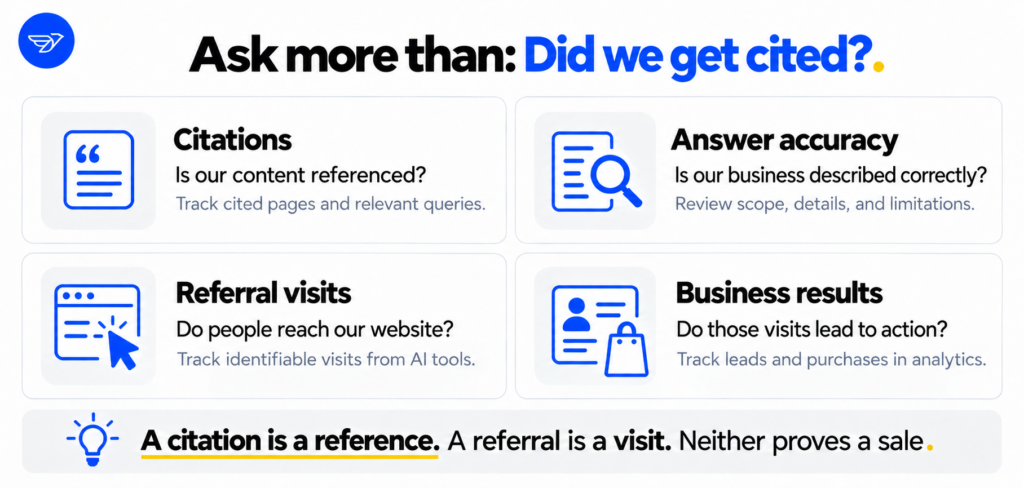
These reports cover different experiences, so avoid treating their combined numbers as a complete picture of AI visibility. Review a consistent set of customer questions to check whether answers describe your business accurately.
Then examine identifiable AI referral visits, leads, and purchases in analytics. A citation records a reference. A referral records a visit. Neither proves a sale. Use all three to understand which content earns visibility and what happens afterward.
Talk to Newbird about AEO and SEO
Start with the questions your customers need answered. Make the explanations clear, support the claims, and measure what happens.
Contact Newbird about AEO and SEO. We’ll review your content, technical foundations, and search visibility to identify the work that deserves attention first.